|
New From Dr. Lam!
Click here! |
|
Change Font Size
|
Video Channel ![]() my new Video Channel ![]() |
|
Related Links
|
|
Client Reviews Lisa describes her personal success with Dr. Lam's Nutritional Coaching Program. Click here to read other reviews! |
|
Have a Health
Question? Ask Me For Free! |
|
|
|
Need to Know
|
Reading Tips:
For fast reading, scan through the topic headings in BOLD BLACK, important conclusions in BOLD BLUE, and "Must Know" in BOLD RED. To jump to specific sections in this article, click on the respective LINKS in the Table of Contents.
Information presented here is for general educational purposes only. Each one of us is biochemically and metabolically different. If you have a specific health concern and wish my personalized nutritional recommendation, write to me by clicking here.
Lipoprotein
A, commonly called Lp(a), is a major independent risk factor for cardiovascular
disease. The optimum laboratory level should be
under 20 mg/dl and preferrably under 14 mg/dl.Fortunately, Mother Nature has provided us a much better
non-toxic alternative. It consist of large
doses of vitamin C, L-lysine, and L-proline. Vitamin C, L-Lysine and
L-proline are the basic building blocks of collagen. When these vitamins enter
our bodies, they form collagen in large amounts. This is necessary, as collagen
must be replenished in blood vessels to remain healthy and plaque free over
periods of time. The reason is simple - Lp(a) is manufacturered in the liver in
response to aging vascular system and "micro-fissures" in the endothelial
vascular wall. The body, in its attempt to patch up these fissures, produce
cholesterol and its relative Lp(a).
Unfortunately, Both cholesterol and Lp(a) are
sticky , making them perfect for the job.
Lp(a) is many times more
potent than cholesterol in its patching ability and has a tendency to attract
other Lp(a) particles. The aggregation of Lp(a) forms a plaque that leads
to vascular occlusion.
This mega vitamin cocktail therapy will increase blood concentrations of
important substances and focuses on:
Only a few animals do not produce their own vitamin C, and humans are one of them. Vitamin C must therefore be taken from external source.
The amount varies between individuals and depends on
the individual's health condition. Heart patients with serious conditions
require more than normal individuals with high Lp(a). Vitamin C is water-soluble. A large amount is needed in order to reach adequate blood and tissue concentration. The amount
of ascorbic acid can be reduced if ascobyl palmitate,
In addition to the above triple cocktail (vitamin C, L-lysine,
and L-proline), other foundational nutrients are important to enhance vascular
wall function. These include vitamin E and L-carnitine, a natural compound
stimulating fatty acid oxidation in the mitochondria. To further enhance
the effectiveness of the cocktail, it is important to use bioflavonoids
and ascobyl palmitate . Many conventionally trained physician uses niacin
to reduce Lp(a). This does work to a limited extend. Niacin reduces the
production of lipoprotein A in the liver, and helps to bring down the lipoprotein
A in the blood. This is what most conventional doctors use. However, this
approach has its limitations because until the endothelial wall is optimized
and cleared, the lipoprotein A level will not be able to reduce significantly.
The effects of niacin usually hit a plateau after 6-9 months of therapy.
If you are on niacin, make sure the liver enzyme levels are taken periodically
to make sure the liver is able to handle the high dose of the niacin.
Improvements
on LP(a) level can usually be seen within weeks to months for the majority
of the people. The higher the starting value, the more significant
was the reduction. Lp (a) can be completely normalized and bought to optimum
level of under 14 mg/dl on nutritional therapies alone if treated properly.
Unfortunately, not all people show positive signs of reduction. Some
people are particularly resistant, and may take upwards of 1 year to effect
minor change. In a small group or people, no change at all can be expected.
All people with high Lp(a) should be started
on a nutritional cocktail. Even if repeat the blood level does not show
any improvement, vascular integrity is enhanced. There is nothing to loose
and everything to gain.
For those who are unfamiliar with Lp(a), here are some articles on this
subject:
RESEARCH ARTICLES ON LP(A)
Angles-Cano ; Structural basis for the pathophysiology of lipoprotein(a)
in the athero-thrombotic process. Braz J Med Biol Res 1997 Nov;30(11):1271-80.
Lipoprotein Lp(a) is a major and independent genetic risk factor for atherosclerosis
and cardiovascular disease. It is relative of LDL or bad cholesterol The
difference between Lp(a) and low density lipoproteins (LDL) is apolipoprotein
apo(a), a glycoprotein structurally similar to plasminogen, the precursor
of plasmin, the fibrinolytic enzyme.
Lp(a) has the capacity to bind, fibrin and membrane proteins of endothelial
cells and monocytes. It also stops plasminogen binding and plasmin generation.
The inhibition of plasmin generation and the accumulation of Lp(a) on the
surface of fibrin and cell membranes favor fibrin and cholesterol deposition
at sites of vascular injury.
_____________________________________________________________
Price KD; Price CS; Reynolds RD; Hyperglycemia-induced latent scurvy
and atherosclerosis: the scorbutic-metaplasia hypothesis. Med Hypotheses
1996 Feb;46(2):119-29.
Latent scurvy is characterized by a reversible
atherosclerosis that closely resembles the clinical form of the disease.
Acute scurvy is characterized by microvascular complications such as widespread
capillary hemorrhaging. Vitamin C (ascorbate) is required for the synthesis
of collagen, the protein that is most critical in the maintenance of
vascular integrity.
In latent scurvy, it has been suggested that large blood vessels use
modified LDL, in particular lipoprotein(a) and collagen to maintain macrovascular
integrity. This is because collagen will be spared for the maintenance
of capillaries, the sites of gas and nutrient exchange.
The foam-cell phenotype of atherosclerosis is identified as a mesenchymal
genetic program, regulated by the availability of ascorbate. When vitamin
C is limited, foam cells develop and induce oxidative modification of LDL.
This stabilizing large blood vessels via the deposition of LDL. The structural
similarity between vitamin C and glucose suggests that hyperglycemia will
inhibit cellular uptake of ascorbate, inducing local vitamin C deficiency.
______________________________________________________________
Chong PH; Bachenheimer BS Current, new and future treatments in dyslipidaemia
and atherosclerosis. Drugs 2000 Jul;60(1):55-93.
Nicotinic acid has been made tolerable with sustained-release formulations,
and is still considered an excellent choice in elevating HDL cholesterol.
It is also potentially effective in reducing lipoprotein(a) [Lp(a)] levels.
Although LDL cholesterol is still the major target for therapy, it is likely
that in future, other lipid/lipoprotein and nonlipid parameters will also
become targets for specific therapeutic interventions.
Other significant lipid/lipoprotein
parameters that have been associated with CHD include elevated triglyceride,
oxidized LDL cholesterol and Lp(a) levels, elevated C Reactive Protein,
elevated homocysteine, and low HDL levels.
Message from Dr. Lam
I hope you have enjoyed reading this article. If you have areas you don't understand,
or if you have a specific health concern, feel free to write to me by
clicking here.
About The Author
Michael Lam, M.D., M.P.H., A.B.A.A.M., is a western trained physician specializing in nutritional and anti-aging medicine. Dr. Lam received his Bachelor of Science degree from Oregon State University, and his Doctor of Medicine degree from the Loma Linda University School of Medicine in California. He also holds a Master’s degree in Public Health. He is board certified by the American Board of Anti-Aging Medicine where he has also served as a board examiner. Dr. Lam is a pioneer in using nontoxic, natural compounds to promote the healing of many age-related degenerative conditions. He utilizes optimum blends of nutritional supplementation that manipulate food, vitamins, natural hormones, herbs, enzymes, and minerals into specific protocols to rejuvenate cellular function.
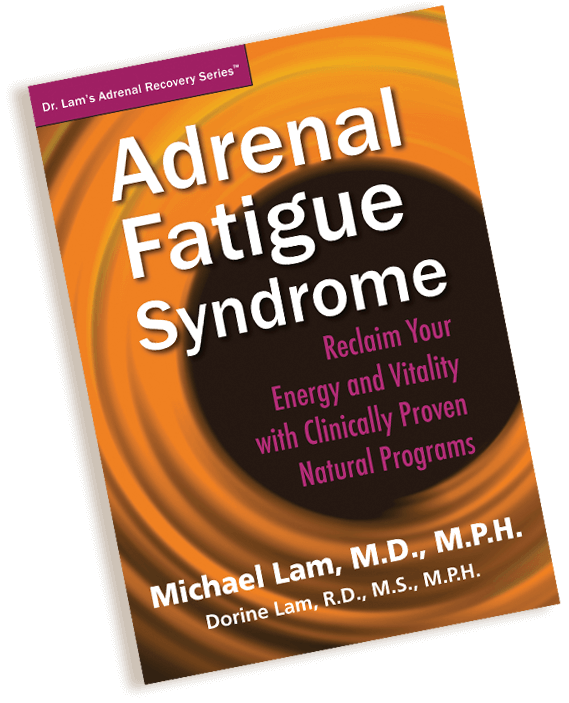
Dr. Lam was first to coin the term, ovarian-adrenal-thyroid (OAT) hormone axis, and to describe its imbalances. He was first to scientifically tie in Adrenal Fatigue Syndrome (AFS) as part of the overall neuroendocrine stress response continuum of the body. He systematized the clinical significance and coined the various phases of Adrenal Exhaustion. He has written five books: Adrenal Fatigue Syndrome - Reclaim Your Energy and Vitality with Clinically Proven Natural Programs, The Five Proven Secrets to Longevity, Beating Cancer with Natural Medicine (Free PDF version), How to Stay Young and Live Longer, and Estrogen Dominance. In 2001, Dr. Lam established www.DrLam.com as a free, educational website on evidence-based alternative medicine for the public and for health professionals. It featured the world’s most comprehensive library on AFS. Provided free as a public service, he has answered countless questions through the website on alternative health and AFS. His personal, telephone-based nutritional coaching services have enabled many around the world to regain control of their health using natural therapies.
For More Information
For the latest Anti-Aging and Adrenal Fatigue related health issues, visit Dr. Lam at
www.DrLam.com.
Feel free to email Dr. Lam by clicking
here if you have any questions.
Ownership and Use
This Web Site and all content and materials included on this Web Site, including without limitation all information, text, graphics, illustrations, photos, video, sound and software (collectively the "Content"), are copyrighted and protected under U.S. and international copyright laws, trademark and other intellectual property laws and treaties and are the exclusive property of Dr. Michael Lam. Dr. Michael Lam hereby retains all right, title, and interest in the Content.
All rights are reserved. You may not store, modify, create derivative works of, translate, distribute, publish, transmit, sell or participate in any sale of, or exploit in any way any Content in any form or by any means. You acknowledge that you do not acquire any ownership rights by downloading material from this Web Site. You are authorized to view this Web Site for informational purposes only. No part of this Web Site or Content can be redistributed, copied, adapted or reproduced without the prior written consent of Dr. Michael Lam.
© 1999-2009 Michael Lam, M.D. All Rights Reserved.